PFAS Analysis: Challenges, Applications, and Reliable LC-MS Solutions
Per- and polyfluoroalkyl substances, also known as PFAS, currently represent an extremely broad class of compounds. Although there is still ongoing debate regarding the exact definition of this group, the most widely accepted definition is that a PFAS is any molecule containing at least one fully fluorinated methyl or methylene group (-CF₃ or -CF₂-).
The first representative of the PFAS family was polytetrafluoroethylene (PTFE), introduced in the 1930s. This was followed in the 1950s by the development of perfluorooctanoic acid (PFOA) and perfluorooctane sulfonic acid (PFOS) by the American company 3M. These compounds paved the way for an era of fluorinated chemistry that has now expanded to more than 4,000 substances catalogued by the Organisation for Economic Co-operation and Development (OECD) and over 12,000 individual PFAS identified by the United States Environmental Protection Agency (US EPA). According to the US EPA, approximately 600 PFAS were estimated to be in commercial use in 2019. Today, databases such as PubChem contain millions of PFAS-related entries.
From an applications standpoint, PFAS represent a remarkable technological achievement. Their very first commercial success remains present in kitchens around the world. Teflon-coated cookware offers a unique combination of non-stick properties and durability, allowing even inexperienced cooks to prepare fried eggs without turning them into scrambled eggs. Other applications include, but are not limited to, grease-resistant paper for food packaging, stain-resistant coatings, cleaning products, paints, varnishes, shampoos, and firefighting foams.
On the other hand, an increasing number of studies have raised concerns regarding the potential health risks associated with PFAS exposure. Although the health effects depend on numerous factors—including age, gender, lifestyle, duration of exposure, the specific PFAS involved, and possibly mixtures of PFAS—evidence suggests that exposure may be associated with thyroid disorders, liver disease, gastrointestinal effects, and cancers such as breast and kidney cancer. Furthermore, maternal exposure during pregnancy has been linked to adverse outcomes in infants, including reduced birth weight and impaired vaccine responses. One study reported that a two-fold increase in maternal serum PFOS concentration was associated with a 39% reduction in diphtheria antibody levels in five-year-old children.
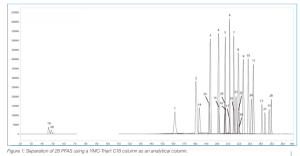
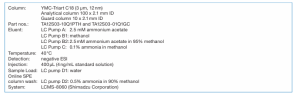
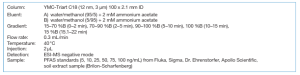
Nakayama et al. (2018) analyzed maternal serum samples using an HPLC system equipped with online SPE in a column-switching LC-MS/MS configuration employing a YMC-Triart C18 column. The method successfully quantified 28 PFAS at concentrations in the ng/mL range. The YMC-Triart C18 column proved particularly suitable due to its excellent mechanical robustness, which minimizes baseline disturbances in highly sensitive LC-MS applications, and its proprietary silica synthesis, which produces an exceptionally inert stationary phase compatible with a broad range of analytes, resulting in highly symmetrical peaks and excellent chromatographic efficiency. The analytical method is shown below.
The increasing use of PFAS over the past decades, combined with their extraordinary chemical stability, represents one of the major challenges in PFAS risk assessment. Their persistence makes them highly susceptible to environmental dissemination through soil, water, and air. In an interlaboratory study reported by Kobayashi et al. (2022), the highest recoveries and reproducibility for the determination of 21 PFAS in water at µg/L concentrations were achieved by a laboratory employing YMC-Triart columns.
PFAS analysis presents a unique chromatographic challenge that often requires the use of not only an analytical column but also a delay column. The purpose of a delay column is to distinguish system-derived PFAS—which may leach from instrument components or be present as contaminants in the mobile phase—from PFAS originating from the sample itself. Consequently, the delay column is typically installed upstream of the sample injector. A delay column may consist of a conventional C18 column (commonly 50 mm in length, with various internal diameters and particle sizes) or a dedicated short stationary phase specifically designed for this application. “Laboratory M” – Kobayashi et al. (2022) -, which achieved one of the best performances in the interlaboratory comparison, employed a YMC-Triart C18 (150 × 2.1 mm, 5 µm) analytical column together with a YMC-Triart C18 (50 × 2.1 mm, 5 µm) delay column.
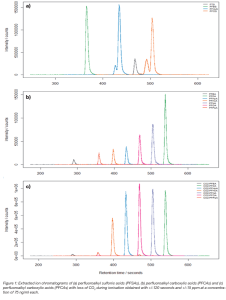
In another study conducted by the Institute for Energy and Environmental Technology e.V. (IUTA), Triart C18 columns were employed for the identification of PFAS and their isomers in contaminated soil samples. As shown below, the method successfully detected perfluoroalkyl sulfonic acids (PFSAs), perfluoroalkyl carboxylic acids (PFCAs), and PFCA fragments generated through CO₂ loss during ionization.
References https://www.ymc.co.jp/data/appli/U250805J.pdf
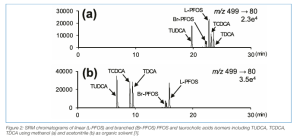
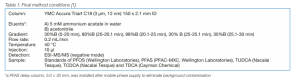
Environmental contamination by PFAS may originate from numerous sources, including industrial effluents, ultimately affecting ecosystems and food chains. Consequently, contaminated water and soil become pathways through which PFAS are transferred to plants, animals, and ultimately food products. YMC-Triart C18 columns have also demonstrated excellent performance in this field, serving not only as highly efficient stationary phases fully compatible with high-sensitivity LC-MS instrumentation, but also as highly selective chromatographic phases. In this application, the selectivity of the Triart C18 column enabled the separation of both linear and branched PFOS isomers while simultaneously resolving potential food-related interferences, such as taurocholic acid isomers.
Reference https://www.ymc.co.jp/data/appli/G260415A.pdf
For more information https://www.ymcamerica.com/ymc-brand/ymc-triart/
References
DECHERNEY, S.; Britannica Editors. Per- and polyfluoroalkyl substance. Britannica. https://www.britannica.com/science/per-and-polyfluoroalkyl-substance (data de acesso 16/07/2026)
Environ. Sci. Technol. 2023, 57, 6647−6655.
FENTON, SE.; DUCATMAN A.; et al. Per- and Polyfluoroalkyl Substance Toxicity and Human Health Review: Current State of Knowledge and Strategies for Informing Future Research. Environ Toxicol Chem. 40(3):606-630, mar 2021. DOI: 10.1002/etc.4890. Epub 2020 Dec 7. PMID: 33017053; PMCID: PMC7906952.
KOBAYASHI, N.; TAKAGI, S. et al. Development and Validation of an Analytical Method for Simultaneous Determination of Perfluoroalkyl Acids in Drinking Water by Liquid Chromatography/Tandem Mass Spectrometry. Journal of Water and Environment Technology. v. 20, n.6: 219–237, 2022. DOI: 10.2965/jwet.22-058
NAKAYAMA, S.; ISOBE, T.; et al. Poly- and perfluoroalkyl substances in maternal serum: Method development and application in Pilot Study of the Japan Environment and Children’s Study. Journal of Chromatography A. 460933, v. 1618, mar 2020. DOI: 10.1016/j.chroma.2020.460933.
SCHYMANSKI, E.; ZHANG, J.; et al. Per- and Polyfluoroalkyl Substances (PFAS) in PubChem: 7 Million and Growing. Environmental Science & Technology. v. 57, n. 44, 16918-16928, 2023. DOI: 10.1021/acs.est.3c04855
TAKAYAMA, T.; SHINGU, S.; et al. Countermeasure for interfered monitoring ion of perfluorooctanesulfonic acid (PFOS) from intrinsic food samples based on LC-MS/MS analysis of per- and polyfluoroalkyl substances. Journal of Food Composition and Analysis. 106436, v. 133, set 2024. DOI: https://doi.org/10.1016/j.jfca.2024.106436
For more information https://www.ymcamerica.com/ymc-brand/ymc-triart/
Related Posts
September 21, 2026
Join us for our upcoming webinar titled Peptide Purification: From HPLC Origins to Process Intensification
September 4, 2026
YMC America Brings U.S.-Supplied ASME U-Stamped DAC Columns to Pharmaceutical Manufacturers

September 10, 2026